 Send to Kindle
We often pride ourselves on our knowledge and ability to pontificate. The “The Smart-Talk Trap
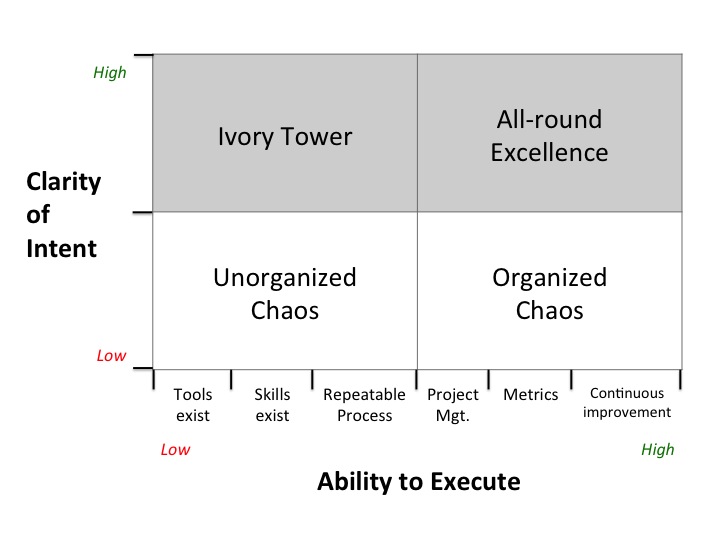
Intent versus execution
If you are not clear about your intent, outcomes sought, goals, vision, and mission, then you will have chaos, no matter how good your execution capabilities. Hence Stephen Covey’s advice to “Start with the end in mind.”
If you do not have execution capabilities, but have clarity of intent, your usefulness is very limited. You will talk more and do less and you will be a barrier to achievements.
The first step is to honestly assess where you stand. Take the capabilities you need and find a spot for them on the matrix.
- Move vertically (upward) by improving the clarity of your intent. Define your vision, mission, and SMART goals. Organize your work into projects, programs, and initiatives; manage them like a portfolio. Meaning, add and remove projects based on priority.
- Move horizontally to the right by acquiring (or building) the tools, training your workforce to use the tools, and define a repeatable process. This is the table stakes to give you any hope of being able to execute. Then move up the food chain by improving your project management, use metrics to take decisions, and use feedback loops to improve.

 that teach how to make meetings useful. Some of them are very good, but most fail to make an impact because the readers tend to focus on the mechanics of meetings: setting the agenda, using a timer, and sending out minutes.