 Send to Kindle
As a leader, you have to inspire others to action. You cannot allow their limitations to come in the way of your compassion and encouragement.
However, as a manager you have to be a little more practical. You cannot put your fate and the fate of your organization in people who cannot deliver. You have to assess quickly whether your co-worker is in the right job, the longer you wait, the more expensive it gets. Take a look at the graphic below:
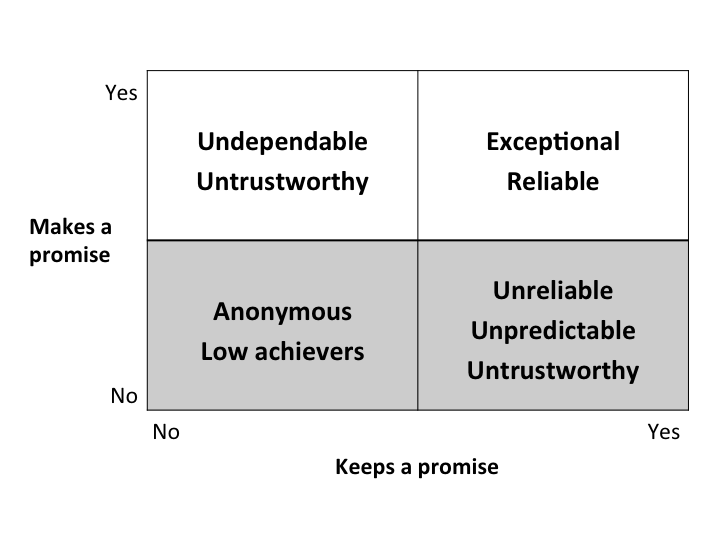
A sniff test to assess dependability.
The key takeaways are:
- Those who can promise/predict success and deliver it (top right quadrant) are the keepers. Sales teams are asked to forecast, software engineers are asked to estimate delivery schedules, and law enforcement officers are asked when the bad guys will be caught. This is a difficult and ambiguous quadrant to be in. Very few make it here and are able to stay here successfully.
- There are those who don’t make a promise, but deliver good work (bottom right quadrant). Their reasoning is, “I did not promise, so what I did is exceptional.” This is a fallacious argument. Such people are unpredictable and unreliable. They lack the confidence and perhaps the skill to be consistent.
- Those who make a promise but cannot keep it (top left quadrant) are even more dangerous, because they lull you into a false sense of complacency. You are encouraged by their positive talk, but frustrated when they are not able to deliver. Such people do not inspire trust and they have an uphill battle to recover the lost trust. They are passive aggressive and are driven by fear of losing a relationship.
- Those who do not make a promise and do not keep one (bottom left quadrant) are the “anonymous overhead” in the organization. They slink into work and watch the time. They can’t wait to collect their paycheck and go home. These people do jobs that can be and will be outsourced. People who fly under the radar are like the rocks below the water surface that sink boats.
As always, your first step is to establish where you are. It is likely you are in different quadrants for different tasks. Set your priorities and move yourself into the top right hand quadrant for tasks that matter. For tasks that don’t matter, you can still be int he top right quadrant. Just make a different promise:
- “I am too busy to do it now.”
- “I change my mind, I would like to excuse myself from this responsibility.”
- “I apologize, but I don’t think this is worth my time. I can suggest someone better for you to work with.”
The key capability you need is the ability to assess your and your co-workers’ capabilities.
