Category Archives: Work

#210 The Strategy and Planning role

Send to Kindle

Every organization needs a strategy and planning role. The only question is, who will perform the role?

First, what does this role do? A senior incumbent will shape and influence strategy. All incumbents will analyze strategy, facilitate conversations to define strategy, clean up ambiguities, resolve contradictions, and keep emotions under control. The output will be a list of initiatives and programs, an estimate of scope, complexity, cost, and a high level roadmap. The outputs will be reviewed and signed off by key sponsors and stakeholders.

In large organizations, this role will be performed by the Chief Strategy Officer. In medium to large companies, this role is performed by a PMO. In small to medium companies, this role is performed by consultants or some hapless soul who looks like he or she needs more work.

Some pieces of the role are core, and thus should be kept with or closely supervised by an employee. It is generally a thankless role and very few individuals have the fortitude to make a career out of it. If you do a tour of duty in a strategy and planning role, you will gain a broader perspective not to be had unless they get to a very senior position.

The most important thing to know about the role: it must be like a dial tone. Always on, always aware, reliable, always ready to connect the dots at a moment’s notice.

Share

#209 Is your boss a keeper?

Send to Kindle

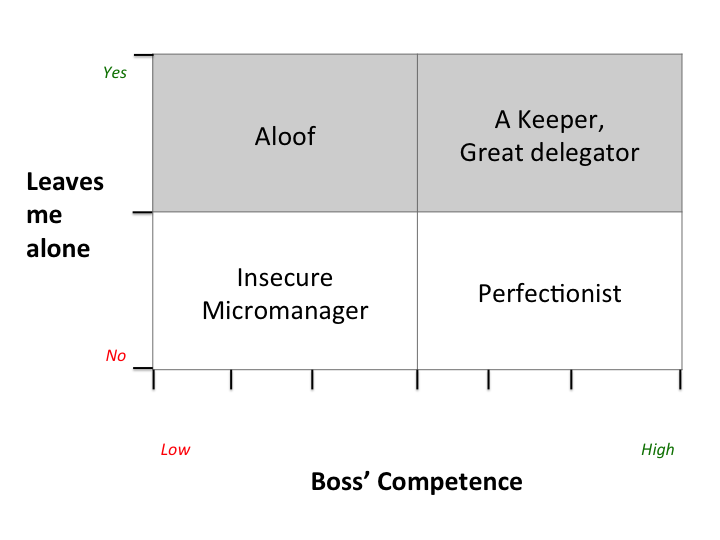
We all have a boss. Love them or hate them, you cannot ignore them. You will get your share of good, bad, mediocre, and unforgettable bosses. If you get a bad boss, unfortunately, you have to adjust our behavior, don’t expect your boss to do the same. An ability to be flexible is probably one of the metrics for spotting a good boss. A framework for your consideration is shown below.

Where does your boss sit on this matrix?

Where does your boss sit on this matrix?

This commentary is a little one sided because it focuses only on the boss’ competence. Nevertheless, it is a guide for your behavior, more than your boss.

First and foremost, the boss has to be competent. “Competence” includes both job related knowledge/skills as well as ability to relate to people, and make them feel good about themselves. If the boss does not know what he or she is talking about, ability to delegate is irrelevant. Once the boss becomes competent, he or she has to work on “letting go.” This means having a tolerance for ambiguity, imperfection, and mistakes made in the learning curve. If your boss is not competent, pray he or she is aloof. At least that will lower the stress on the job. However, don’t expect your career to grow unless you are an exceptional performer anyway.

Having an incompetent boss is no excuse for not managing your own career. While your career may look like it has hit a speed bump, you can work hard to increase your competence. Bosses are impermanent (yes, there may be exceptions to this rule), so in addition to managing the current one, you have to prepare for the next one.

Share