Category Archives: Work

#145 Assessing reliability

Send to Kindle

In an earlier blog, we talked about assessing dependability. That is only one part of the equation for evaluating your capability to execute. The other part is the reliability.

In measuring dependability, we look at whether a promise was kept. In reliability, we look at the speed of keeping a promise.
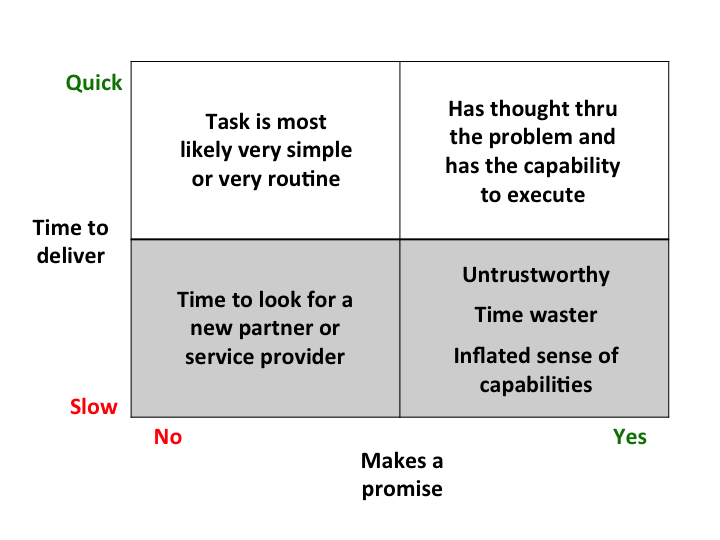
Measuring reliability

Measuring reliability

This is not meant to be a six sigma level measurement. Often a quick assessment is not only cost effective, but a career saver. Be sure to use data, not your opinion. One fail safe way to implement this is to make a clear and explicit request. Then measure how quickly you got the request serviced.

Be sure to understand your role in this equation. If you do not have clarity on outcomes or what success looks like, you should spend time getting this, or ask for help to define success. Clarity includes matters like budget and timeline, and any constraints that you may be aware of. If you make a foggy request, it is unfair on your part to hold your partner or service provider accountable.

If your partner or service provider does not understand your request or cannot help you clarify it, it is definitely time to get a new partner or service provider. Don’t settle for second best, because that is what you are going to get.

Share

#142 Using frameworks

Send to Kindle

Frameworks are useful, but they are often misunderstood. There is no shortage of frameworks, every self respecting organization has one. We have one too! Why are frameworks loved and why are they ignored, even mocked?

Frameworks are excellent analytical tools. They help you understand the problem domain. They help you see the problem in different ways, and more quickly. As you know, speed (to insight) is king in the modern workplace.

The problems arise when you expect frameworks to be applicable out-of-the-box or to be predictive. Frameworks cannot do this, no matter how good they are. If you have found one, please let us know in the comments below. You cannot force yourself or your organization into a framework.

The real problem is that you want to abdicate your responsibility to think. In the need for speed, and the need to be productive, you try to give up thinking, but you are trying to automate the wrong things. Automating your thinking and decision making takes time to get it right and will work for only those situations that can be well defined and reasonably static.

So go forth and harvest frameworks. Adapt them, evolve them, create your own. Use it to improve communication, collaboration, and planning. That alone will save you a lot of time.

Share