Category Archives: Work

#208 Intent versus Execution (a sniff test)

Send to Kindle

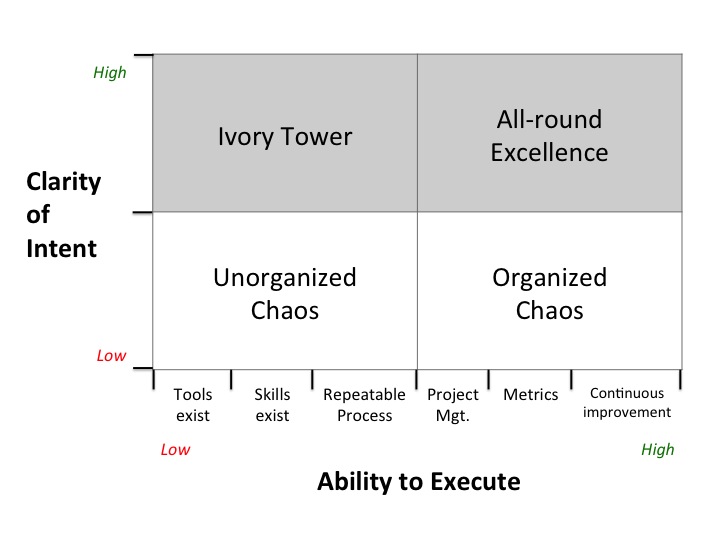
We often pride ourselves on our knowledge and ability to pontificate. The “The Smart-Talk Trap” is something we fall into often. If we sound good, we must be good, right? At some point, we have to stop talking and start doing, meaning, we have to show the ability to execute. Here is a framework to assess where you stand in your execution capabilities and how to improve.

Intent versus execution

Intent versus execution

If you are not clear about your intent, outcomes sought, goals, vision, and mission, then you will have chaos, no matter how good your execution capabilities. Hence Stephen Covey’s advice to “Start with the end in mind.”

If you do not have execution capabilities, but have clarity of intent, your usefulness is very limited. You will talk more and do less and you will be a barrier to achievements.

The first step is to honestly assess where you stand. Take the capabilities you need and find a spot for them on the matrix.

  • Move vertically (upward) by improving the clarity of your intent. Define your vision, mission, and SMART goals. Organize your work into projects, programs, and initiatives; manage them like a portfolio. Meaning, add and remove projects based on priority.
  • Move horizontally to the right by acquiring (or building) the tools, training your workforce to use the tools, and define a repeatable process. This is the table stakes to give you any hope of being able to execute. Then move up the food chain by improving your project management, use metrics to take decisions, and use feedback loops to improve.
Share

#207 Rejection

Send to Kindle

No one likes a rejection, but my hypothesis is that most rejections are imagined, not real. When your audience is saying “no” or pushing back, they could be merely confused and saying, “I don’t understand.” Or, they could be saying, “I don’t believe you.” In the worst case, they could be saying, “I don’t trust you.” (In this last case, you are really in trouble. Stop reading this blog and get professional help ASAP)

Assuming you are facing the first two cases, try asking these questions next time you feel you are being “rejected:”

  • How do you know? Is the words being used? The tone of voice?
  • Was the decision predetermined? Could you have done anything about it? If “no,” is it really a rejection?
  • Are they saying, “Not now” or “Never?” The distinction is important, in the former case, you still have hope. In the latter case, you can safely cut your losses and move on.
  • Is your audience willing to share the reasons for the rejection? It really hurts when they don’t, now the ambiguity is frustrating. What can you say to get a truthful answer?

Ultimately, a lingering negative thought after a rejection is a problem, because you might be rejecting yourself. Yes, be angry, but be brief about it. The time to recover has to be short, and now you have to deal with reality. Turn anger into determination, and “show them.” Winning elsewhere, living well, and being happy is the ultimate revenge. Rejections make acceptance sweet.

If you are suspicious about an acceptance after numerous rejections, well, that’s a subject for a different blog.

Share